THE FLUSH FALLACY: WASTING WATER AND POTENTIAL
By SynganicEd — Myth-Buster, Rhizosphere Rat, Enzyme Evangelist
You flushed 15 gallons through your pots two weeks out—then blamed the terps?
Flushing before harvest has become cannabis cultivation gospel. But like most unquestioned practices, it’s overdue for a reality check. You’ve been tricked into starving your plants for smoke smoothness. What if one of growing’s most sacred rituals is actually sabotaging your harvest quality?
The Synganic approach isn’t about tradition—it’s about results. And the data on flushing doesn’t match the hype.
WHERE THE FLUSH DOCTRINE CAME FROM
Flushing originated from legitimate soil concerns: when using heavily amended organic media for long cycles, occasional leaching helped clear salt buildup. Made sense.
“Two week flush minimum or your buds will taste like chemicals. This is basic knowledge.” —GrowGuru420, ICMag Forums, 2007
But then something twisted happened. Forum wisdom from 2005–2012 on platforms like ICMag, Rollitup, and GrassCity transformed this occasional maintenance technique into a mandatory pre-harvest ritual. Major nutrient brands like General Hydroponics, Advanced Nutrients, and FoxFarm baked it into their feeding schedules, reinforcing the practice without evidence.
Most telling? The rise of specialized “flush products” (Flawless Finish, Clearex) that claim to magically extract nutrients from your plants. Read the MSDS—they’re mostly chelators like citric acid, sugars, and magnesium sulfate. Not detox agents.
MYTH VS LABEL: FLUSH PRODUCT INGREDIENTS
| Label Claim | MSDS Reality |
|---|---|
| “Removes excess nutrients from plant tissue” | Citric acid (chelator) |
| “Pulls fertilizer salt deposits out” | Magnesium sulfate (Epsom salt) |
| “Purifies your harvest” | Sugar water + preservatives |
The truth: They’re selling you watered-down Epsom salt and calling it innovation.
THE PHYSIOLOGY FAIL
Here’s what’s actually happening inside your plants during a flush:
- Starving ≠ Detoxing. You’re not cleaning, you’re cannibalizing.
- Mobile nutrients like N, P, K, and Mg are scavenged from lower leaves.
- Immobile nutrients (like Ca and Fe) stay locked in plant tissue.
The University of Guelph and Rx Green Technologies both conducted studies that found no significant differences in bud mineral content, potency, or terpenes from flushing. None. In the Rx Green study specifically, blind taste testers couldn’t reliably identify or prefer flushed plants over unflushed ones.
What does happen? Your plants trigger stress responses. Trichome development stalls. Yield drops. Terpene synthesis tanks.
- Stress signaling
- Trichome development stall
- Reduced terpene synthesis
- Yield reduction
Think about what this means for flavor. That Wedding Cake strain known for its vanilla-cake complexity? A harsh flush can flatten that vanilla note, leaving you with generic sweetness. That Gelato #33 losing its citrus edge because you stopped feeding during peak terpene production? That’s not “cleaner” smoke—that’s lost flavor molecules that never formed.
THE “CLEAN BURN” OBSESSION
White ash is not proof of purity—it’s proof of combustion physics.
White ash is linked to complete combustion and mineral content—not “clean” buds. Harshness in smoke is far more influenced by proper drying and curing than by your feeding schedule. When you over-flush (especially in coco/hydro), you don’t cleanse your plants—you starve them during their most critical expression window. The dry, brittle buds some mistake for “clean” product are actually just underdeveloped.
THE RHIZOSPHERE REALITY
Flushing doesn’t just starve your plants—it devastates the rhizosphere. That living zone where roots interact with beneficial microbes, mycorrhizal networks, and enzymatic processes gets shocked when you suddenly flood with plain water.
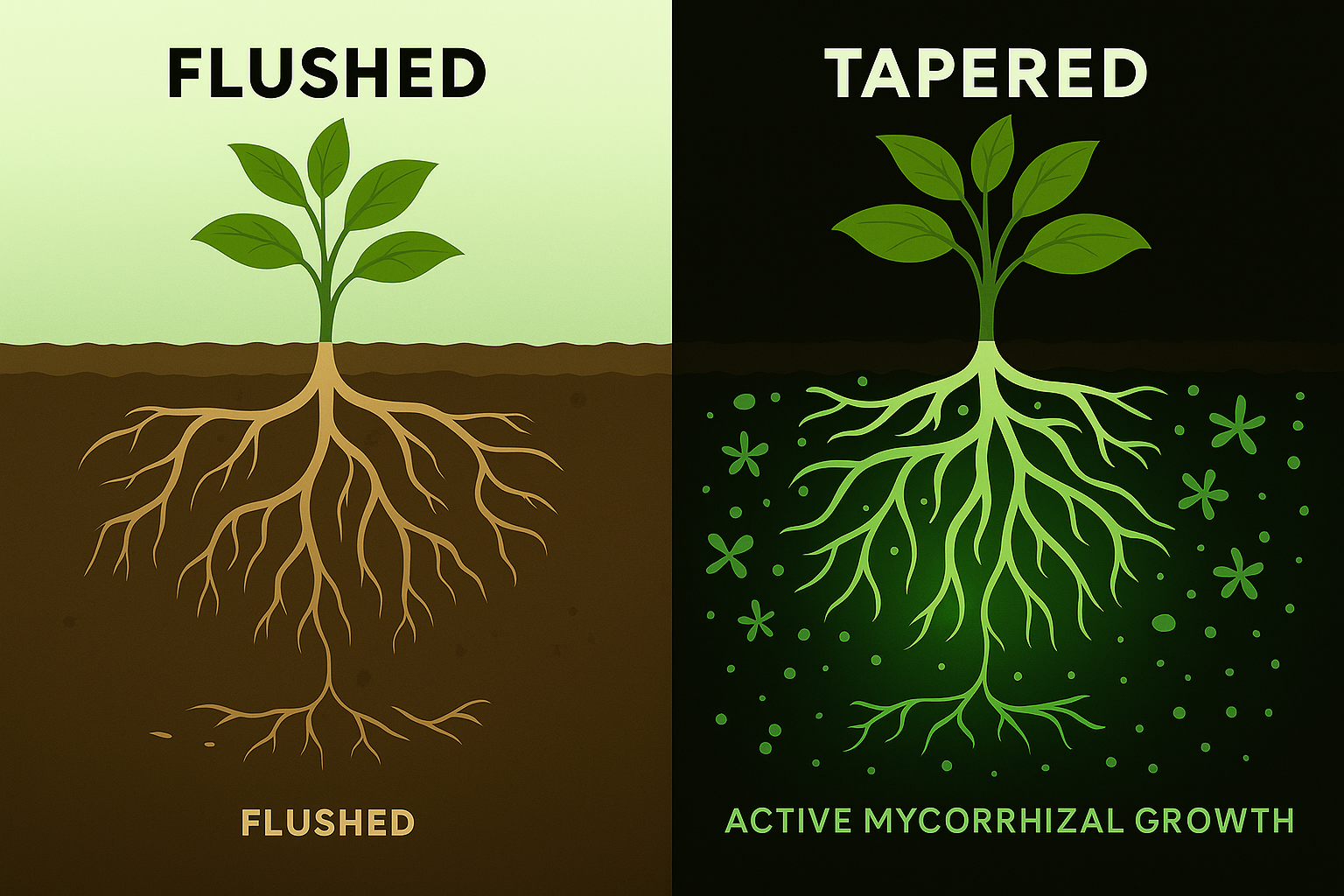
In organic or hybrid setups, this disrupts the biological continuity your plants rely on. Those microbes breaking down complex nutrients? Shocked. The mycorrhizae extending your roots’ reach? Compromised. The enzymatic buffering that stabilizes pH and nutrient availability? Diluted to ineffectiveness.
A thriving rhizosphere doesn’t need a flush—it needs a stable transition to senescence that preserves microbial populations, sustains humic cycling, and maintains fungal respiration until the very end. Many growers who switched from flushing to tapering with compost tea support report deeper, more complex flavor profiles that carry through long cures.
THE SYNGANIC APPROACH: TAPER, DON’T GHOST
4-STEP FLUSH FIX
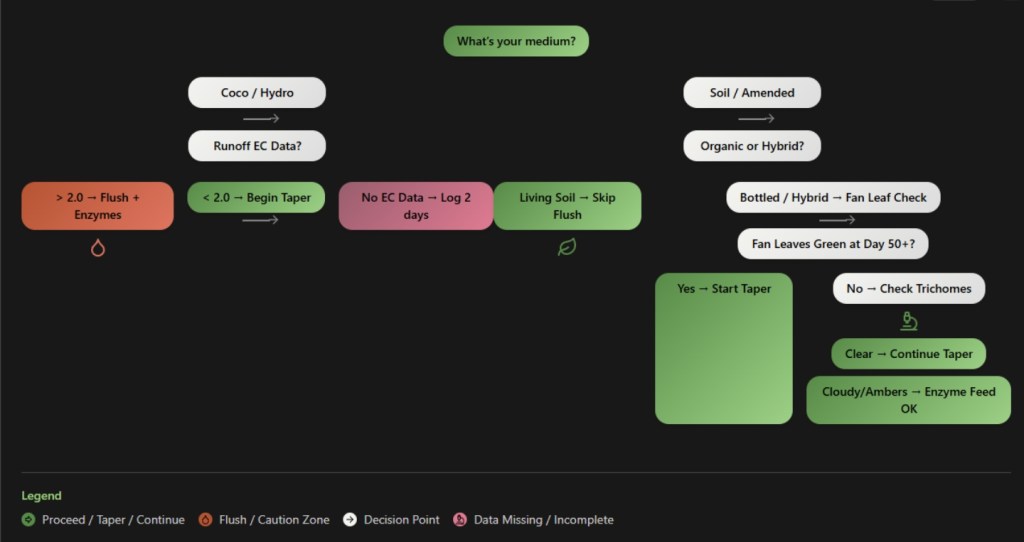
- Gradually reduce nitrogen to under 80ppm by week 8, cutting base nutrients to 50% while maintaining calcium/magnesium at full strength
- Keep EC between 1.4–1.0 during weeks 8–9, tapering to 0.8–1.0 in the final 5 days
- Apply beneficial enzymes (300ppm) and maintain root zone inoculants through light feeds
- Monitor runoff EC (target: ≤ 1.2) and pH shifts as your signal—not calendar days
For hydro/tent systems, adjust taper if runoff EC spikes above 1.5. This works even in small-scale tent setups. The principles scale from closet grows to commercial operations.
If you wouldn’t starve a pregnant goat, don’t starve a flowering plant.
In coco and hydro especially, excessive flushing creates extreme stress that blocks the plant from finishing properly. A short (2–3 day) rinse is fine if you’ve tapered correctly—but even that should include minimal root zone support.
TRUST SYSTEMS, NOT SUPERSTITION
You’re not cleansing your plants. You’re ghosting them during the most critical period of expression.
The Synganic method isn’t about rejecting all tradition—it’s about testing assumptions and building systems that deliver results. Flushing is a leftover ritual that’s costing you quality, yield, and time.
This isn’t about trashing tradition—it’s about evolving it with better tools and better data. When you replace superstition with systems thinking, your plants respond with deeper flavors, fuller expressions, and more consistent finishes.
Still flushing? You’re not harvesting cleaner—you’re harvesting scared.
Next Read: Buffer Zones: Why pH Management Isn’t What You Think
Tell Us: What’s your flush horror story? Drop it in the comments for an upcoming roundup post.

 Synganic Gardening
Leave a comment